Published March 6, 2025
Previously, I authored an article about an envelope sent from China to Mishawaka that I purchased through an eBay listing. That same seller was also selling an envelope sent from Japan to Mishawaka that I also purchased. Both were weathered, old envelopes, but what intrigued me was that they were sent from East Asia almost a century ago. The one envelope from China, was from the 1920s – 1930s, and the other sent from Japan was also from around the 1920s – 1930s. The envelope from China was sent originally by Rev. Ellen Studley, a Mishawaka native who had done missionary work for the Methodist Church in China during the Chinese Civil War and World War II. Despite neither of the senders being the same people, I found multiple interesting parallels between them. The sender of the Kobe, Japan, envelope was a woman named Esther (Ludwig) Martin, and this is her story.
Esther Ludwig was born on January 14, 1878, in Penn Township to Herman and Sarah (Stierlen) Ludwig. Herman unexpectedly passed away at age 25 only one month after Esther was born, which left Sarah as a single mother to three children. Sarah remarried a widower named Richard Buckbee, and the family went to live with him and his children on his farm just outside of Mishawaka.
Esther grew up in and around Mishawaka during her entire childhood. After getting her education, she decided to become a schoolteacher. One of the schools she worked at was Elder School in South Bend, where she taught for a number of years. She was an active member of the First Methodist Church of Mishawaka, where she participated in a large variety of events.
In June 1914, Esther married Dr. James Victor Martin in St. Joseph County. James was a teacher and a Methodist missionary. The newlyweds decided to go on a mission trip to Japan and set sail in August of that year. Esther had never traveled abroad before; James, however, had previously done a four-year missionary trip to Japan. Esther and James had four children, all of whom were born in Japan.
While they lived in Japan, the family did go back and forth to the United States. When the family visited Mishawaka, they stayed at the home of Vernice Ludwig. Vernice was Esther’s older brother, and he was a prominent businessman. He was the Director of Sales at Ball-Band, being employed there for over 41 years, a member of the Ball-Band Foremen’s Club, and the Fellowship Club. Vernice lived at 329 Edgewater Drive in Mishawaka, just a few houses down from the Studley family. This address is important as the envelope that started this search was sent by Esther from Kobe, Japan, to Vernice’s wife, addressed as follows: “Mrs. V.F. Ludwig, 329 Edgewater Drive, Mishawaka, Indiana, U.S.A.”
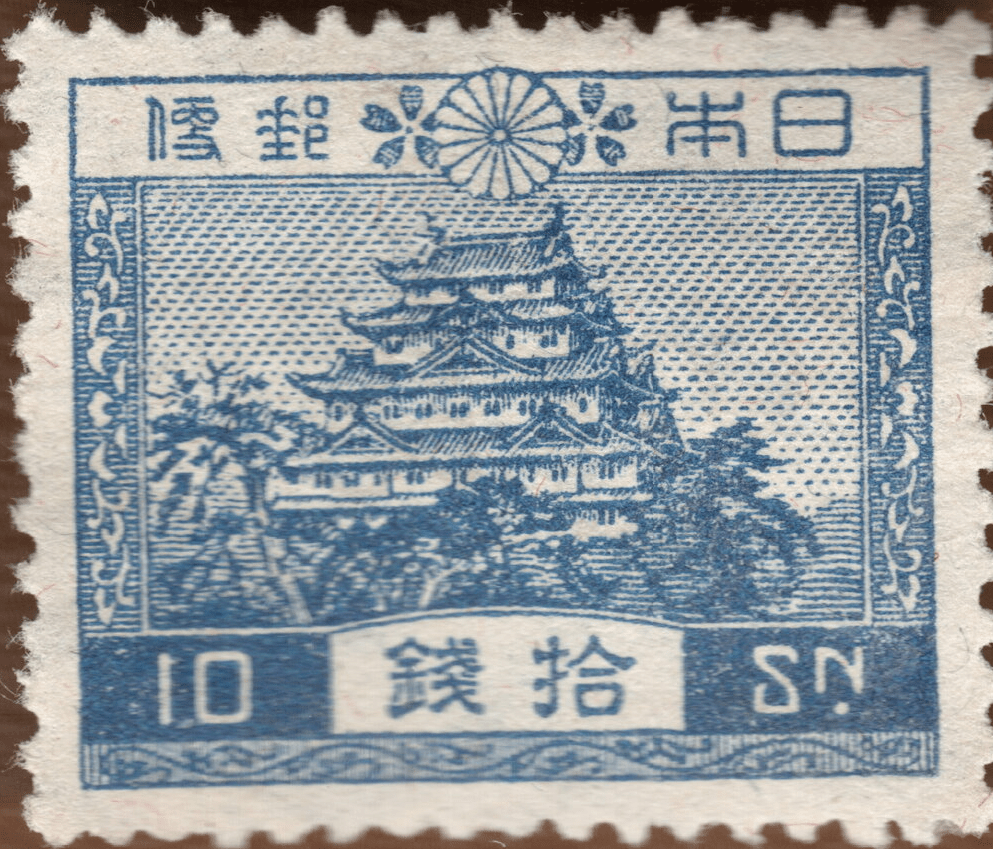
Dating old envelopes is not easy, and typically the best way to determine when it was sent is by inspecting the stamp. The Martins lived in Japan for a number of years, so to narrow it down was like searching for a needle in a haystack. The stamp was blue with a distinct looking castle as the art. After some investigation, I discovered that the stamp was 10 Sen (1/10 of 1 Yen). I eventually was able to find out that it was called the “Blue Nagoya Castle 10 Sen Stamp” and that this blue variety was only printed in 1926, which perfectly corresponds with a specific mission trip to Japan that was mentioned in the South Bend Tribune from that year.
In 1926, the couple embarked on a mission back to Japan. James had ambitious goals while in Japan: to create new methods of teaching English to Japanese students and to standardize tests. James then taught the principles of phonetics, to help sound out the words better, making the students understand the new language better. His main goal, however, was having a phonetic English dictionary published to be put into the curriculum for missionary English teachers in Japan. He succeeded in this goal, and in the fall of 1926, the book was published, and 1,000 copies were sent all across Japan. The phonetic dictionary consisted of 10,000 of the most commonly used English words and had the words all sounded in both Standard English and in American English. At the time, he claimed that this was the first book to have this distinction of Standard English and American English, which could help the Japanese students better understand and notice accents. Esther helped her husband do the behind-the-scenes work with preparation of the curriculum, helping write documents, homemaking, caring for their children, entertaining guests, and sending out letters across the world. One such envelope she sent out that summer is the one that I purchased off eBay.
In 1926, the Martins also traveled to and taught in Tokyo, Japan. Some of Esther’s letters were published back home in the South Bend Tribune. In one letter published in the Tribune, Esther complained of the heat of the Tokyo summer. One day while out walking, she developed heatstroke and got terribly ill. She became bedridden and had to have ice packs put on her for a few days until she fully recovered. Besides the heat, Esther seemed fond of Japan. She mentioned that after her husband invited students to lunch at their house one day, the children were fascinated with their western style home and items like an iron and ironing board. The reason the concept of an ironing board fascinated the Japanese children probably is that traditional Japanese clothing would have used different materials that would not need to be ironed and that ironing probably would have also damaged the materials, making such a device pointless to them. In the same letter, Mrs. Martin mentioned how a guest who temporarily lodged at their home was a fellow missionary and grandson of Bishop Earl Cranston of the Methodist Church. Bishop Cranston’s grandson was stopping in Japan before going on to western China.
After the 1926 mission, the Martins stayed in Japan for the majority of their time. In 1941, this all changed as tensions between the United States and Japan had increased and war looked on the horizon. Due to the hostilities, the Martins were recalled to the United States, making it the final time Esther would set foot in Japan. They left just in time as, months later, Japan’s attack on Pearl Harbor officially started the war between the two countries. During World War II, both of her sons, James Martin, Jr., and Harris Martin, served overseas in the military as lieutenants in the Pacific Theater. They probably were sent to the Pacific because of their fluency in Japanese, which helped them excel in the U.S. armed forces. Also, during the war, Esther’s daughter, Sarah, worked as an interpreter for the Dutch Economic Commission in Australia. While three of her children were overseas around this time, tragedy struck when on April 10, 1945, as Esther (Ludwig) Martin passed away at age 67 at her home in Santa Clara, California.
It is interesting that two unrelated envelopes sent from separate countries to Mishawaka being sold by the same shop from New York State on eBay have so much in common. Esther (Ludwig) Martin’s family lived on the same street and only a few houses down from Ellen Studley. They both attended the First Methodist Church in Mishawaka, and both became missionaries and went on mission trips in Asia in the 1920s. It shows that in a lot of ways that Mishawaka is ultimately a personal and connected community rather than just a city. I learned a lot while writing these articles, and I am glad to have stumbled across these envelopes almost one hundred years later. These articles will help preserve the memories of these Mishawakans and share the stories of their adventures abroad.
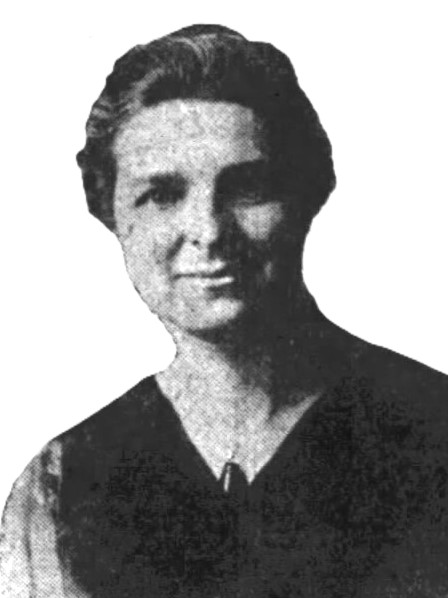
Esther (Ludwig) Martin in 1926
 Articles by Josh Lange
Leave a comment