Published December 19, 2024
As a seventh generation Mishawakan, and someone who has a deep appreciation for history, I scour the internet for any items relating to Mishawaka. Recently, I came across two eBay listings from a postal memorabilia shop in Mount Kisco, New York. Both were weathered, old envelopes sent to Mishawaka, but what intrigued me was where they were sent from, East Asia. One envelope was sent from China, dated from the 1930s, and the other was sent from Japan in the 1920s. Despite none of the senders or recipients being the same, I discovered that both were connected and that the stories behind them are fascinating. Both of the senders lived selfless and exciting lives. The envelope that is the focus of this article was sent by a Mishawaka woman named Ellen Studley.
Ellen Maria Studley was born on May 27, 1899, to George and Edith (Tyler) Studley in Grand Rapids, Michigan. The family moved to Mishawaka when Ellen was a child. They lived at 451 Edgewater Drive in Mishawaka. George was a prominent businessman, being the manager of the Production Schedule Department and the head of the Timekeeping Division at Ball-Band. He also served as a board member of the First Methodist Church and was a member of Lodge 130 of the Free and Accepted Masons. George worked at Ball-Band for 22 years until his unexpected passing at age 57. Edith was an active member of the church as well, serving in many events and helping out with Sunday school. Ellen was one of three children. The other two were Lillah, who was the Mishawaka High School Class of 1924 valedictorian, and Elbridge, an officer in the Navy during World War I.
Ellen excelled academically at Mishawaka High School, being voted best student her senior year. She participated in lots of extracurricular activities and was a member of the Booster’s Club and the History Club, the Vice President of the Debating Club, and editor-in-chief of the Miskodeed in 1916. She graduated in Mishawaka High School’s Class of 1917 and was the 437th graduate of Mishawaka High School. She then went to college, getting her undergraduate degree at DePauw University and her M.A. in Religion at Boston University.
The First Methodist Church meant everything to Ellen. One of her dreams in life was to become a missionary. This aspiration however was not exclusive to just Ellen, as another young woman who was a fellow member of the local Methodist congregation, and friend of Ellen’s named Esther (Ludwig) Martin had this dream too. Esther grew up at 329 Edgewater Drive and was a close neighbor with Ellen. The Japan envelope was sent from Esther, and her story will be told in a later article.
In 1924, after graduating college, Ellen wanted to spread the word of the teachings of Jesus Christ, so she joined the Women’s Foreign Missionary Society. She was assigned to China and set sail on the passenger liner President Polk on November 8, 1924, from San Franscico to Shanghai. After arriving in China, she initially worked as the secretary for Bishop George R. Grose, the former President of DePauw University, who was also there on missionary work. This mission was the start of Ellen’s almost 30-year career in China. After her secretary position, she started her work as a teacher to give a formal education to the poor and needy. She started off teaching in Peking, also known as Peiping, which today is Beijing, China’s capital. Throughout her decades in China, Ellen traveled to many places. Her arrival in China was fortuitous, as this was a time of hardship for the Chinese people.
Ever since the collapse of the Qing Dynasty in 1912, the country was reformed into the Republic of China (R.O.C.). The R.O.C. was not so much a unified nation, but rather the Beiyang government claiming to be the rulers of the R.O.C. with little influence over the entire country. There were other factions that splintered off from the government, such as the Kuomintang (K.M.T.) and the Chinese Communist Party (C.C.P.), who aligned in a coalition to overthrow the Beiyang government. Most regions of China were independently controlled by warlords, a large number of whom sided with the Beiyang government. The reason the warlords sided with the Beiyang government is due to the government being extremely incompetent and full of corruption, making it easy to take advantage of.
By 1926, the K.M.T. started going to war with the regional warlords sided with the Beiyang government in what is known as the Northern Expedition. The K.M.T. believed that China needed to end the warlord system and unify the whole nation under one leader with a strong centralized government. The K.M.T. won, which resulted in the Beiyang government collapsing, making the K.M.T. the new rulers of a majority of Chinese territory. K.M.T-ruled China was known as Nationalist China. In 1927, the Chinese Civil War officially started between the Communists and the K.M.T. as their common enemy, the Beiyang government, was vanquished and both parties wanted all of China for themselves. To make matters even more confusing, the Empire of Japan saw a power vacuum in the region and started to occupy parts of claimed Chinese territory as well.
Ellen and her fellow missionaries were caught in the crossfire of this ever-growing war, figuratively and literally. In 1928, hostilities had increased among all of the factions of the war, and it had arrived on the doorstep where Ellen Studley and other missionaries were. She was in the town of Taian in the Shandong region, which at the time was in extreme famine from opposing forces preventing food and other vital goods being released to the populace. Tragedy struck on April 29, 1928. During a battle, one of Ellen’s friends and fellow American missionary Emily (Hatfield) Hobart was killed. Ellen wrote a letter to the American Methodist Episcopal Mission headquarters in Shanghai explaining what happened. This letter was sent by wire back home to the news media.
Excerpts of the letter were published in the South Bend Tribune on May 11, 1928, and reads as follows: “The killing of Mrs. Hobart on April 29, was after the nationalists had arrived and fighting was proceeding. We were warned that it was unsafe to leave the compound, but did not know we were being made targets. Mrs. Hobart left the sitting room where she had been reading and went to a bedroom which has a small window above the door facing the city hall. She was hit by a bullet through the window fired from the wall. She was conscious 10 minutes and died in one hour.” The second excerpt elaborated, “From that time on, we lived in the basement of the mission building, being fired at every time we left the building. It was not known what particular group of southern soldiers was doing the firing.” Mrs. Hobart’s memory was immortalized by her alma mater, Northwestern University, where an all-female dorm named in her honor still stands.
By the 1930s, as the Chinese Civil War worsened and with the Second Sino-Japanese War approaching, the school Ellen taught at was now in a region marked as a “Demilitarized Zone.” Nothing discouraged Ellen Studley from her faith in God and her goal of improving lives. She briefly left China in late 1936 and returned on New Year’s Day in 1937. She was assigned to another school located at “31 Yu Fang Hutung, Teng Shih K’ou, Peiping,” the same location that the envelope I purchased was originally from. Peiping ended up eventually in the hands of the Japanese, who at first did not interrupt the foreign missionary work as they were not at war with the United States at this time. While the date of this envelope is not known, with the help of a friend who knows Mandarin, and dating the stamps, it is safe to assume it was sent to Mishawaka sometime between 1936 – 1941. On December 8, 1941, one day after the Japanese attack on Pearl Harbor, the Japanese forces shut down Ellen’s school and would not let any of the foreign missionaries leave.
In March 1943, Ellen was transported by the Japanese occupiers to the Weihsien Internment Camp along with thousands of other foreigners. They assigned her as “Number 841,” and she was forced to work whatever tasks her captors gave her. While Ellen and the rest of the missionaries were not starved, they were given limited rations by the Japanese, which led to significant weight loss for many. Ellen was one of the first people at Weihsien to be released, due to a prisoner exchange between the United States and Japan. She was put on the M.S. Gripsholm, a vessel under the flag of Sweden, a neutral country in World War II. In December 1943, before Ellen returned to the United States on her 11-week voyage, her mother Edith, now living in California, suffered a massive stroke. Ellen stayed in the United States until the end of the war and cared for her mother. After Edith passed away at 74 in 1946, Ellen decided to go back to China to continue her work as a teacher and a missionary.
Ellen returned to Peiping in early 1947. The Chinese Civil War had resumed, and the only factions left were the Chinese Communists led by Mao Zedong and the remnants of Nationalist China led by Chiang Kai-Shek. She helped start a new school and eventually became the principal. By 1949, when the Communists won the Civil War, she was advised to leave but refused. In a 1967 interview by the South Bend Tribune Magazine, when asked why she stayed in China despite all the pressure, Ellen responded, “I felt that the Christian witness was needed no matter what kind of government was there.” However, by 1950, she was left as the only American at the school and knew that she had no other choice but to leave after being monitored by the Communist secret police due to the Cold War starting and the deteriorating relationship between China and the United States. This was the last time she would ever set foot in mainland China.
Ellen, back in the United States, joined the Chinese Students and Alumni Services (C.S.A.S.) as an executive secretary based out of Chicago. The C.S.A.S. helped with Chinese students living abroad in the United States. In 1956, Ellen made history becoming the first woman in the Midwest to be ordained as a Methodist minister. She became known as Rev. Studley and traveled to Taiwan for a few missions. After Taiwan, she stayed in the United States for the remainder of her life, moving to California and Illinois. In her later years, Rev. Studley volunteered for Habitat for Humanity. Rev. Ellen M. Studley passed away peacefully on August 11, 1989, at the age of 90 in Los Angeles, California. She lived a fulfilling life, and the testimony of her character inspired thousands throughout the decades. I am grateful to be able to share her story, as it is one that I would have never known had I not stumbled across that envelope listed on eBay.

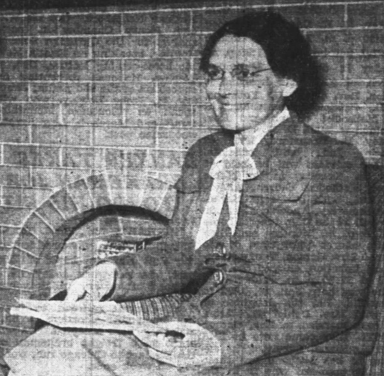
Rev. Ellen Studley at age 25
 Articles by Josh Lange
Leave a comment