Published September 26, 2024
When people think of the Manhattan Project, they think of Fat Man and Little Boy, the two atomic bombs dropped on Japan to end World War II. With the release of the critically acclaimed film Oppenheimer, people now also associate the project with more key facts as well. The first is the legend himself, J. Robert Oppenheimer, who headed the project in Los Alamos, New Mexico. The other major fact is that of the Trinity Test, where the first atomic bomb was detonated on July 16, 1945, in White Sands, New Mexico. The Manhattan Project was not just a handful of scientists at a top-secret base in the New Mexico desert, but rather one of the largest projects in history. Over 500,000 people contributed to the project by the time it was completed in 1945.
For years it has been known that one Mishawaka resident, Staff Sergeant Charles Rupchock helped in the project. SSgt. Rupchock was a member of the Army Corp of Engineers and helped with construction at and around Los Alamos, New Mexico. Recently, I discovered that there was a second Mishawakan involved in the Manhattan Project. His name was Arthur Karler.
Arthur was born to Jewish Eastern European Immigrants Max Karler and Florence (Feldman) Karler, in Mishawaka on March 11, 1920. Arthur was the oldest of Max and Florence’s six children. He spent most of his childhood living at 325 East 10th Street, the house sadly no longer exists and is now an empty lot. He excelled academically from a young age. Max Karler had a softball team, “The Karlers,” in Mishawaka’s B-League. The team won many victories over the years, and the love of sports inspired his kids to participate in both high school and college level sports.
Arthur attended Mishawaka High School and graduated in the class of 1938. He was in both the Science Club and Honorary Scholastic Society. Arthur was awarded multiple scholarships, such as a full ride scholarship to Indiana University, but ultimately chose Purdue. While there, he was a member of Delta Rho Kappa, a Distinguished Student, and a member of Phi Lambda Upsilon. He graduated from Purdue in the Class of 1942 with a Bachelor’s in Science.
Arthur was not the only member of his family to attend Purdue, as his younger brothers Charles and Robert were students there as well. The three brothers lived together at Purdue and were all majors in science related fields. Charles was the star pitcher for the university’s softball team and was active in other sports, however, he never had the chance to graduate due to a tragic and freak accident while at Shafer Lake near Monticello, Indiana, where he was killed shortly before his sophomore year on August 5, 1942. Charles is buried at the Hebrew Orthodox Cemetery in Mishawaka. His epitaph reads “A student of life”.
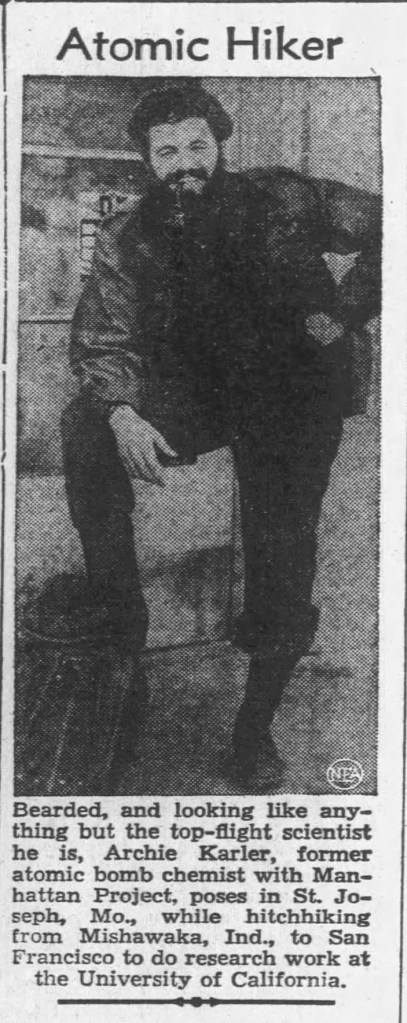
Grappling with the death of his brother, Arthur pressed on with his pursuit of science to help change the world. A 1943 article of the South Bend Tribune said he was accepted into pre-medical school at Indiana University Bloomington and was expected to start in May 1944. However, from late 1943 to early 1947, there is a black hole of information for Arthur, and that is due to his involvement in the Manhattan Project and its highly secretive nature. However, by January 1947, he reappears in the news and is referred to by the nicknames of “Archie” and “Beardo” in an article reprinted in newspapers across the country. The article, which is slightly edited from paper to paper, refers to him as a bearded, high achieving atomic scientist who worked on the Manhattan Project as a chemist. The details of the facility he worked at and his specific role as a chemist in the Manhattan Project largely remain unknown due to the nature of the project itself. The topic of the 1947 article is how he decided to walk and hitchhike from Mishawaka, Indiana, to the University of California at Berkeley, where he would do graduate research there for an atomic cure for cancer.
While at Berkeley, Arthur met the love of his life, Mildred Templer, who was a fellow student. Mildred was from Chicago and served in the Red Cross during World War II. She was a social worker and had two daughters with Arthur. They settled down in El Cerrito, California, just north of San Francisco.
Arthur went on to become a doctor and at one point had his own laboratory. He was a speaker at numerous scientific conferences and had at least a half dozen patents to his name. He was even quoted in newspapers in the 1960’s talking about laboratory-grown synthetic meat being a potential food source of the future. To say he had a successful career would be an understatement, as his patents are still being used to this day.
Arthur and Mildred were married for 54 years, until her passing in 2002. Even in retirement, Arthur stayed active in his community and scientific circles. He passed away on January 3, 2013, at age 92. His epitaph reads “Soldier of Science,” a perfect description of his character.
While Arthur Karler had grand achievements in his life from his humble beginnings in Mishawaka to a top scientist in his field, the most important contribution he made to our civilization was his work on the Manhattan Project. People simplify and condense history. Most would just say that the Manhattan Project was a project that gave us nuclear bombs, but it is so much more than that. The Manhattan Project catapulted the human race into a new age, the Nuclear Age. We created nuclear energy, particle colliders, and so many advancements that were previously inconceivable. We have the power to split atoms, the literal building blocks of the universe. All the advancements we have today and will have in the future would not have been possible without the Manhattan Project, a project that will still be a talking point in history books hundreds of years from now. With that legacy, Arthur Karler and every other scientist on that project will never be forgotten.
 Articles by Josh Lange
Leave a comment