Published May 8, 2025
Mishawaka is home to many with the name Wood in some capacity such as legendary basketball coach Marvin Wood, Mayor Dave Wood, Councilman Dale “Woody” Emmons, and even softball coach John “Woody” Woodruff. Each of these Woods have something in common: none of them has ran for President, yet. There is a Wood, however, who did run for President and campaigned in Mishawaka 105 years ago. General Leonard Wood (no relation to any Wood previously mentioned) was the presumed frontrunner for the Republican Party in the 1920 Presidential Election. Despite being largely forgotten by history, Leonard Wood made significant contributions to our nation.
Leonard Wood was born on October 9, 1860, in Winchester, New Hampshire, to Charles Wood and Caroline (Hagar) Wood. His father was a medical doctor and served in the Civil War as a hospital steward. Leonard followed in the footsteps of his father, becoming a doctor himself. While in graduate school at Georgia Tech, he played on and coached their football team. Leonard joined the U.S. Army Medical Corps and had one of the most successful careers in the Army’s history. He served 36 years in the Army, during four wars, and attained the rank of Major General. He is most famously known as one of the commanders of the Rough Riders and being a close friend to President Theodore Roosevelt. Wood achieved dozens of awards, including the Medal of Honor.
General Wood became a nationally recognized figure after becoming the military governor of Cuba under President McKinnley and President Roosevelt, as well as becoming the Chief of Staff of the Army under President Taft and President Wilson. He spearheaded the Preparedness Movement in the early years of World War I before the United States joined. General Wood argued that the war would come to the United States eventually and that America should build up its armed forces. This caused tension with Democratic President Wilson, who believed in neutrality from the war, but he eventually changed his mind in 1917, with the United States formally joining the war.
After World War I concluded, the incumbent Wilson administration was on its way out, and the upcoming 1920 Presidential election became a free for all, with every prominent political figure throwing their hat in the ring, including General Wood. The major contenders in the field included Governor Frank Orren Lowden of Illinois, Senator Hiram Johnson of California, and much later in the race, Senator Warren G. Harding of Ohio. General Wood had a large amount of support from a chunk of the Republican base, but his stances on key issues made him an easy target for his opponents. The most controversial stances General Wood had with Republicans was his support of joining and growing the League of Nations as well as supporting mandatory military service for young men.
During the Republican primaries, Wood was in multiple close races with Hiram Johnson, leading to the popular vote mainly splitting between the both of them. While Senator Johnson was winning the popular vote over General Wood by a couple percentage points, Wood won more delegates. The two of them were not gaining enough ground, and with the primary season coming to a close, one of the last primaries left to potentially make one of these men stand out was Indiana.
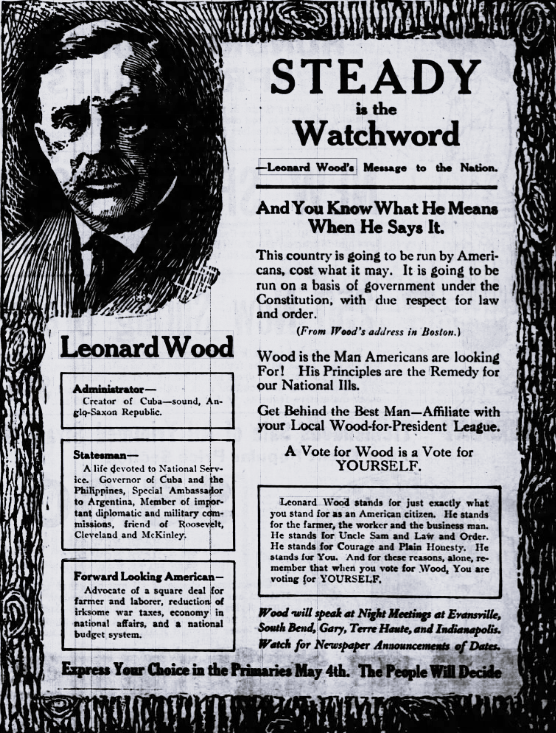
In the latter half of April, every campaign descended on Indiana, with the most money being spent by the Johnson and Wood campaigns. General Wood began an advertisement and speech blitz across the entire state. On April 29, advertisements started to appear in local newspapers that General Leonard Wood would give short stump speeches in Goshen, Elkhart, and Mishawaka, with a main event speech in South Bend on May 1. While General Wood had these advertisements in most newspapers, there were none regarding his Mishawaka visit in The Mishawaka Enterprise. My theory is that while his main speech in South Bend had been planned possibly weeks in advance, his campaign decided to include short stump speeches beforehand in a last-minute effort to drum up more support, as a 3-day notice for a political event seems too short of a window.
On Saturday, May 1, 1920. General Wood finished his stump speech in Elkhart a little after 12:30 p.m. and got into his motorcade, which started driving down the Lincoln Highway toward Mishawaka. His convoy of cars included supporters and local Republican Party members. The weather was perfect for a speech. It was clear to partly cloudy and around 50 degrees. Awaiting General Leonard Wood and his entourage, Mishawaka had prepared the downtown for his speech. It had been determined that his speech would be given at the front entrance of the Hotel Mishawaka on South Main Street. Colonel Charles Carlisle, a prominent South Bend businessman had been put in charge of the arrangements. The police had shut down the roads in a three-block radius of the hotel while the reception committee waited. At 1:30 p.m. the convoy of cars turned onto Main Street from Lincolnway, passing the Phoenix Building and the First National Bank. They stopped less than a block away from the Hotel Mishawaka. Ball-Band sponsored a marching band to play songs for the audience and increase excitement for the event. With the music playing, General Wood exited the vehicle and walked toward the front of the hotel. He was dressed in his military attire and walked up the steps to stand next to the temporary podium. Mayor Ralph Gaylor of Mishawaka introduced General Wood and then moved away from the podium to let him speak. Leonard Wood looked out to the crowd on Main Street as he spoke. The crowd was smaller than expected, consisting of an estimated 300 Mishawakans.
While what Wood said was never transcribed, his speech in South Bend later that day was. It is safe to assume that the stump speech in Mishawaka was a shortened version of the South Bend speech. His talking points likely consisted of the potential threat of communism, lowering the cost of living, expanding the Merchant Marine, exporting more commodities, implementing elastic tariffs, eradicating preventable diseases, supporting mandatory military service, joining the League of Nations, and increasing pay for teachers. After the Mishawaka stump speech, General Wood went to South Bend to give his main speech at the Bob Jones Tabernacle to an audience of around 6,000 before leaving the area later that evening.
On May 4, Mishawakans cast their ballots, and the results were shocking. First, the turnout rate was incredibly low. The Mishawaka Enterprise remarked, “No interest was taken in the primary” and “687 [total votes for both parties combined] in the primary of yesterday, seems ridiculous, and the stamp of disapproval against the primary law is apparent.” For context, Indiana did not have primaries prior to 1916, so this would have been the second Presidential election with the new system. The second shocking result was the winner. Despite General Wood winning the state of Indiana, he lost in Mishawaka even though he was the only candidate to give a speech here. The results were that a total of 387 votes were cast by Republicans in the Presidential race with 226 of the votes for Senator Hiram Johnson, 140 votes for General Leonard Wood, and 21 for other candidates. This means only 36% of Republicans voted for General Wood in the city. According to the census, Mishawaka in 1920 had a population of 15,195, which might lead one to assume that there was a sparse number of registered voters, but that could not be further from the truth. In the general election on November 2, 1920, over 4,398 Mishawakans cast their vote for President, a 600% increase from the May primary election. While primaries always have significantly less turnout than general elections, it is typically not as extreme of a difference.
While we will never know with complete certainty as to why General Wood lost in Mishawaka, there are multiple potential reasons. What is apparent more than anything is the voter apathy at the time. He also must not have appealed to Mishawakans, as General Wood only got 140 votes. Now assuming that the super majority of the 300 people at his Mishawaka speech were registered voters, less than half cast their vote for him. It is also fair to assume even more Mishawakans traveled to the main speech at the Tabernacle in South Bend, as it was noted in multiple newspaper articles that the crowd consisted of residents from across the region. Senator Johnson did not speak in Mishawaka, and he handily won by large margins. Perhaps Mishawaka Republicans simply disagreed with key policy stances made by General Wood, and the apathy was due to no candidate at the time standing out.
This voter apathy and unpopularity in Mishawaka was not unique, rather a perfect microcosm of that election cycle. Wood went on to a strong opening at the Republican National Convention: winning the first four rounds of the Presidential ballot, getting second place in the fifth round, getting a tie in the sixth, winning the seventh, and losing the rest. He came incredibly close to being the Republican nominee for President. Had he been nominated, he could have very well been elected President. His problem in the convention was that even though General Wood won multiple rounds, he could only win a plurality and never was able to appeal to a majority of Republicans. This was seen in most primary results as well especially with Indiana, where he won the state with only 37% of the vote. The ultimate victor of the Republican National Convention was Warren G. Harding, the dark horse who was viewed as a compromise candidate between the factions. Harding went on to win the Presidential election in a landslide, becoming the 29th President.
Despite falling into obscurity with modern America, General Leonard Wood played a vital role in shaping our country and the military as a whole. After the 1920 Presidential campaign, Wood went on to be appointed as Governor General of the Philippines by President Harding from 1921 until his death on August 7, 1927. Fort Leonard Wood in Missouri was dedicated in his honor. He also has the honor of being one of only a handful of Presidential candidates to give a speech in Mishawaka alongside Robert F. Kennedy Sr., George H.W. Bush, and Hillary Rodham Clinton. When will another Presidential candidate give a speech in Mishawaka? Only time will tell.

 Articles by Josh Lange
Leave a comment