By Joshua David Lange
As someone who is interested in Mishawaka history, I recently saw an eBay listing that caught my eye: an intact letter that was sent from Mishawaka, Indiana, to Enfield, Connecticut, postmarked November 19, 1842. I wondered what the contents of this letter were and took a gamble throwing out a bid in the auction. To my surprise, I won the auction.
To put into perspective how long ago 1842 was, Indiana only had 600,000 people, Mishawaka had less than 1,000 people, there were only 26 states with Michigan being the newest, and Notre Dame had just been founded in a log cabin by Father Sorin.
After the letter arrived, I opened it up to see this beautiful cursive that was also foreign to me as modern cursive is more legible. I brought the letter to the Mishawaka Historical Museum to donate. I asked if somebody could help with transcribing the letter, and the museum director as well as Mishawaka’s Historian Laureate, Pete De Kever, took on the challenge to painstakingly decipher this 183-year-old letter. After two hours of work, Pete handed me the transcription, and I was shocked to find the contents had information that is crucial to Mishawaka history from this time.
The letter was written by a Mishawaka farmer and machinist, Reuben Chapin, to his brother, Daniel Chapin. The letter starts off as a basic letter from that era, talking about how Reuben misses his brother, Daniel, “Dear Brother, perhaps you may think, by my not having directed any of my letters to you of late, that I have forgotten our former friendship. I would therefore say that my regard for you is not in the least diminished.”
The letter then goes into what Reuben was personally dealing with in Mishawaka, where he mentions an illness that spread through the village: “There was a prevailing disorder through this section of the country in the hottest weather called the Bowel Complaint. Old persons and children mostly died that were taken. But those in the prime of life mostly recovered. We had scarcely any Fevers this fall and taking it altogether it was considered quite healthy; it is now very much so.”
At the time, it is reasonable to assume this “Bowel Complaint” was either dysentery or cholera, which were all too common on the frontier. Mishawaka does not seem like the frontier, but the town in 1842 was vastly different from the modern world. It went from uninhabited bogs and forests on the river to a town in only nine years at this point. Mishawaka in 1842 had no proper infrastructure, medicine, schools, or railroads.
Reuben gives an insight into what the settlers of Mishawaka ate writing, “We had a plenty of Apples this fall, as well as Peaches, and Melons.” He then mentioned that the abundance of crops caused the demand to crater, writing the following: “The farmer has abundance of all kinds of produce and makes great complaint because he cannot dispose of what a bounteous Providence has bestowed upon him. You will see by the following prices that they are merely nominal: Wheat at present 40 cts. per bushel, ½ cash, ½ trade Rye “35 cts., no cash Barley “20 cts., no cash Corn “12½ cts., cash Oats “$4 per ton, English $7, no cash Pork for making into [unclear] $3 per [unclear] for hogs weighing 250 lbs and [unclear]. There will not be any put up for the Eastern Market. — Beef is at 2¢ per lb, and no cost. Potatoes 18¾¢ trade, Turnips 12½¢ also trade, Onions 62½¢, Cabbages 3¢ per head. Butter ten to 12½¢ for the best, very little money. Cheese 7 to 8¢ but of poor quality.”
One shocking discovery was that many pigs were bred and slaughtered within the town of Mishawaka to the point pigs outnumbered people at least 4 to 1. Reuben wrote, “There has been about 1000 hogs already killed here this fall and will amount by spring to about 4000. The manner of doing is this: the hams and shoulders are taken out of the hogs and put up in brine for sale. The whole of the backbone and ribs with as much lean meat as can be taken off with it is sold to the inhabitants at what they can get per pound. The heads, after taking off the fat, and the legs are given to whoever will take them away. The whole of the broadside fat as well as all the other fat is tried up into lard. They then go through a process by which the oily particles is extracted into oil for burning and for machinery. What is left is for making into candles.”
Historian Pete De Kever explained that pork was the easiest way for those farmers to make money with animals and their crops. Farmers could sell pigs more easily because they used corn to feed the pigs. Then they could walk the multi hundred-pound pigs to the market to sell. One cannot, however, just walk hundreds of pounds of corn or the barley to market without a mule or a horse and wagon.
What is also interesting is realizing that the hogs helped fuel the factories in pioneer Mishawaka with their fat used to make oil for the machinery because petroleum was not used for lubricants or lamps for another 20 years.
Reuben Chapin mentioned, “Game is more than plenty — quite plenty. Turkeys still more so. Partridges very thick. Squirrels — Fox, Black, Grey, and striped ones — without number. Also quails in every direction, with a plenty of rabbits and Prairie Hens, as well as Ducks.”
One of the animals Reuben mentioned, the Prairie Hen, is a bird that has now been extinct in Indiana for well over half a century. Indiana looked radically different back then. There were wetlands, old growth trees, and animals that no longer live in our state.
The most interesting section of Reuben’s letter is about the temperature. 1842 had an unusually cool summer: “We have had frost every month since the year commenced, I will here mention the time of the unusual frosts the past season. Frost June 10th that put down most of the Corn. Frost July 5th only in slight degree. Frost August 1st also a slight one. Frost Sept 19th at which time we generally look for frosts to commence with alternate good and bad weather for something about two months.”
Reuben then mentioned the snowfall: “The first flakes of snow fell on the 8th of this Month [November]. But on the 11th it fell 5 inches deep. It cleared up again and bid fair for good weather. But on the 16th it snowed slightly in the forenoon but melted considerably in the afternoon. it turned around bad and commenced blowing with flurries of snow up to the present time. Saturday 19th A.M. The sun shines out since I commenced this page, and I think it will be quite mild by Monday. It has been a remarkable season for so much good weather, and then so suddenly to turn around and be so bad. If it continues as it has begun, it will be altogether the severest winter that I have seen in this country.”
This letter is so remarkable because there are few surviving documents with this much information about Mishawaka in 1842. Reuben mentioned the crops grown, the animals that were bred, and specific dates for frost and snowfall. If this was a typical letter, it would not have had this vital weather and agriculture data. This is genuine information that the National Weather Service and economists can use today. There was no official weather-keeping in 1842, and newspapers prior to 1845 in Mishawaka are nonexistent. This letter fills a gap in the historical record that would otherwise be impossible to reconstruct.
Before I left the letter at its permanent home, Pete De Kever told me it was amazing to think that this letter was written and stamped in the city almost two centuries ago, made it all the way to Connecticut, then somehow ended up with an eBay user in Chicago who decided to put it up to auction. The letter survived 183 years without damage, just to return back to the place it was sent from. If that is not a historical miracle, then I do not know what is. I hope the letter from Reuben Chapin paints a picture of the life of Mishawakans in 1842.
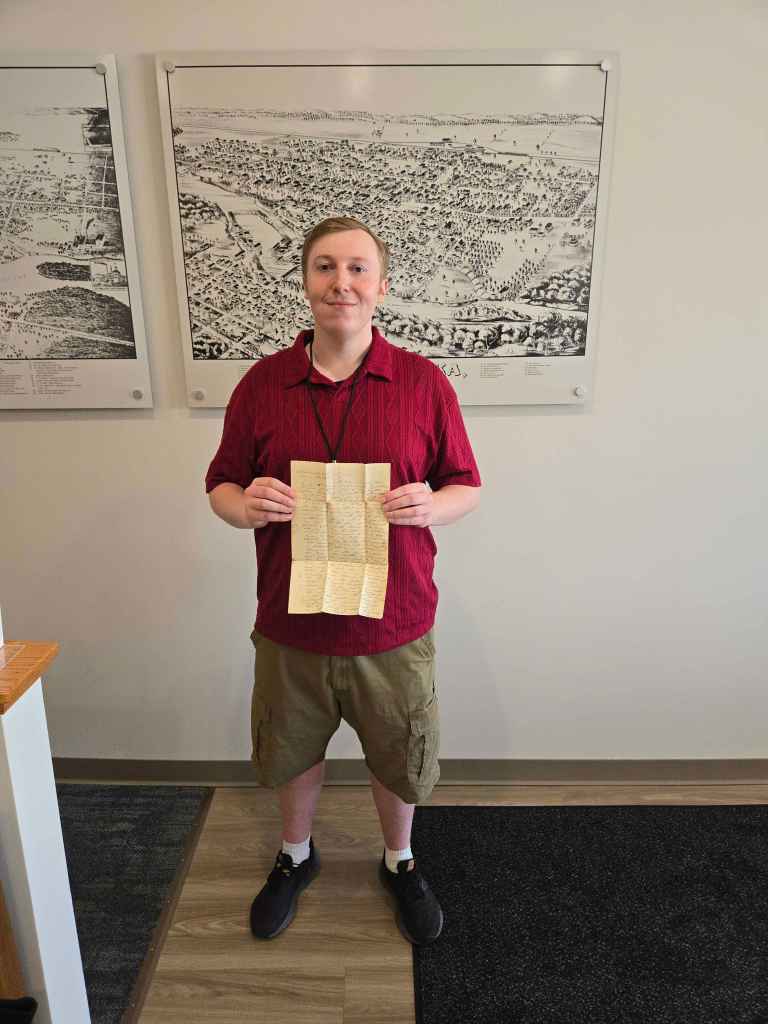
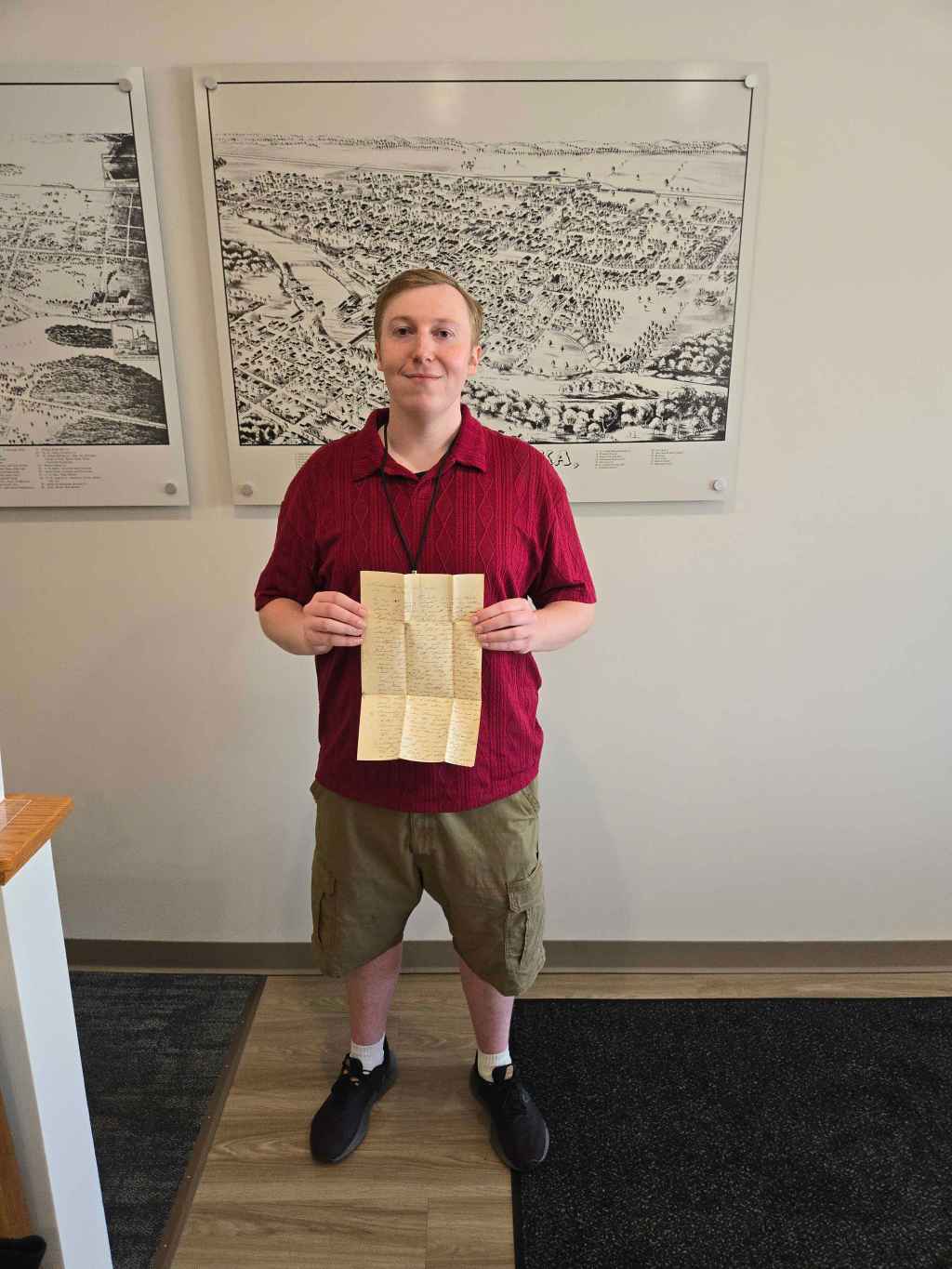
Historian, Josh Lange, holding the 1842 letter at the Mishawaka Historical Museum (Photo by Peter De Kever)


Leave a Reply